Zohar Bachiry

Shows how post-anesthesia recovery capacity can become a bottleneck that delays OR turnover, increases idle time, and disrupts the rest of the surgical schedule.
The Post-Anesthesia Care Unit (PACU) is the supervised recovery space where every surgical patient lands immediately after receiving general anesthesia — and when PACU beds fill faster than patients clear them, the entire surgical day backs up. In many hospitals, PACU capacity constraints are a primary driver of OR holds, causing completed cases to remain in the operating room while recovery beds are unavailable [1]. AHRQ data found 14.4 million OR procedures in U.S. hospitals in 2018, generating $210 billion in costs — and OR time runs $36–$47 per minute [2][3]. When a PACU bottleneck stalls even one OR room for 30 minutes, the downstream cost is measurable in thousands of dollars of idle capacity and extended nurse overtime. We work with OR & PACU managers across the country — at programs that have cut PACU-driven holds by 76% with proactive scheduling [Opmed PACU Implementation] — and the surgical programs running the tightest daily schedules treat PACU throughput as an OR scheduling constraint, not an afterthought. Below, we explain what PACU is, why it functions as the operational choke point in most perioperative suites, and what operational changes separate high-throughput programs from those still fighting avoidable holds.
🎯 Key Takeaways
PACU is a post-surgical recovery unit: Every patient receiving general or regional anesthesia typically moves directly to the PACU after leaving the OR for monitoring until medically stable for discharge home or to a floor bed.
PACU holds are a direct OR scheduling problem: When PACU is at capacity, completed cases cannot leave the OR, blocking room turnover and delaying the next case on the board [1].
OR time costs $36–$47 per minute: A single 30-minute PACU-driven OR hold costs a facility an estimated $1,080–$1,410 in idle OR capacity, multiplied across multiple rooms and multiple holds [3].
22% of surgical patients experience PACU delays: A Thomas Jefferson University Hospital study found 22% of surgical patients experienced PACU-related delays before a multi-disciplinary intervention reduced that rate to 7% [4].
Optimized sequencing can reduce PACU holds by 76%: Research from Lucile Packard Children's Hospital Stanford demonstrated that procedure-sequencing optimization reduced total PACU holds by 76% without decreasing OR utilization [1].
Automation is the operational lever: Opmed customers report a 20% reduction in PACU congestion and 15–20% savings in nurse overtime costs after implementing AI-driven PACU scheduling [Opmed PACU Implementation].
What Is the PACU in a Hospital?
The Post-Anesthesia Care Unit — universally abbreviated as PACU — is the staffed recovery area where patients are monitored for 30–90 minutes after surgery until they are medically stable enough to transfer to a floor bed, step-down unit, or discharge to home. For surgical programs operating under general, regional, or monitored anesthesia care, the PACU is a mandatory clinical stop: registered nurses assess vital signs, pain levels, airway patency, and emergence from anesthesia before clearing a patient for the next level of care.
PACU operations are typically divided into two phases. Phase I (also called Phase 1 or "high-acuity PACU") is for patients recovering immediately post-anesthesia with close 1:1 or 2:1 nurse-to-patient monitoring. Phase II (step-down recovery) handles patients who have met Phase I criteria and are progressing toward discharge or floor transfer. Average PACU length of stay for Phase I patients ranges from 71 to 131 minutes depending on case complexity, anesthesia type, and intraoperative fluid management — with actual stays frequently running 20–30 minutes longer than the medically appropriate window due to throughput constraints [5].
PACU nurse-to-patient ratios are tightly regulated by the American Society of PeriAnesthesia Nurses (ASPAN) and state-level nursing boards. Staffing typically runs 1:1 to 1:2 in Phase I depending on acuity, which means every bed requires dedicated personnel. A study published in the Journal of PeriAnesthesia Nursing found that shifting from a 1.2:1 to a 1:1 nurse-to-patient ratio through optimized scheduling reduced PACU length of stay and improved throughput at a large academic medical center [6]. The staffing math is unforgiving: every minute a bed stays occupied beyond medically necessary time is a minute a new post-surgical patient cannot move out of the OR.
Why PACU Directly Impacts Your OR Schedule
The operating room and the PACU are connected by a one-way patient pipeline. Every OR case that ends without an available PACU bed creates what perioperative leaders call a "PACU hold" or "OR hold" — a situation in which the surgical patient remains in the OR under anesthesia provider supervision because there is no recovery bed to receive them [1]. Holds interrupt turnover, delay subsequent case starts, and compress the entire surgical day.
The financial impact concentrates quickly. At a conservative $36 per OR-minute, a 30-minute hold costs $1,080 in idle room capacity — before accounting for extended anesthesiologist time or over-utilized OR hours. At the ACS-cited figure of $36–$47 per minute, 10-minute delays can cost up to $470 per OR room per incident, with those costs multiplying across a 10- or 20-OR surgical program [3]. A perioperative suite running 3 ORs simultaneously with two PACU holds of 20 minutes each loses more than $4,000 in a single morning.
The Thomas Jefferson University Hospital experience illustrates the scale. In September 2018, 22% of surgical patients experienced a PACU delay — meaning roughly 1 in 5 cases triggered a hold or extended boarding event. A multidisciplinary intervention that restructured recovery flow brought that rate down to 7% within 12 months, reducing Phase 1 recovery time from 131 to 69 minutes (a 48% reduction) and total PACU LOS from 220 to 182 minutes [4]. The operational unlock was not more beds or more staff — it was better coordination and predictive sequencing.
"If the PACU reaches capacity, patients must wait in the operating room until the PACU has available space, leading to delays and possible cancellations for subsequent operating room procedures."
— Health Care Management Science, Zhan et al., 2026 [1]
That dynamic is self-compounding. When OR holds back up the schedule, surgeons and anesthesiologists face compressed case blocks, staff are asked to extend into overtime to clear the board, and the next day's first cases start from a position of catch-up rather than clean slate. The Springer/Health Care Management Science study at Lucile Packard Children's Hospital Stanford demonstrated that procedure-sequencing optimization — matching case order to predicted PACU LOS patterns — reduced total PACU holds by 76% without any reduction in overall OR utilization [1].
The Mechanics of PACU-Driven OR Disruption
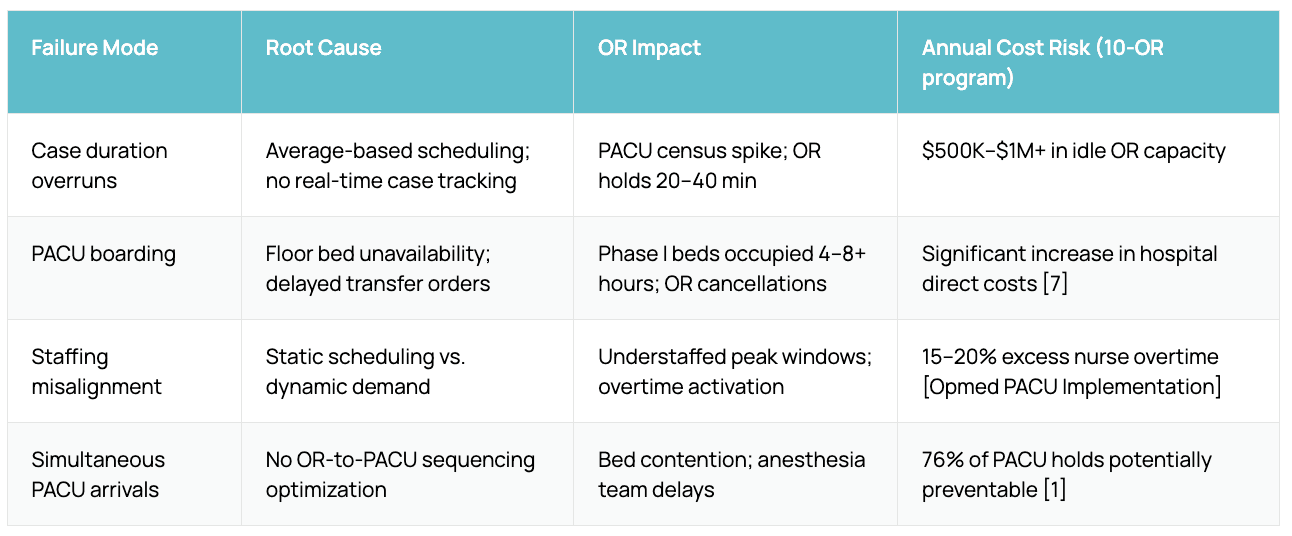
Understanding why PACU backs up requires mapping the 3 failure modes that cause holds to cluster:
1. Case Duration Unpredictability
Cases that run long — or that involve higher fluid loads or complex regional blocks — produce longer Phase I recovery windows. When these cases are sequenced consecutively in adjacent ORs without accounting for PACU timing, multiple patients arrive in recovery simultaneously, overwhelming available beds within a 15–20 minute window. Traditional scheduling uses historical averages; average-based scheduling cannot prevent simultaneous PACU arrivals when case lengths vary by 30–60 minutes from predicted [1][5].
2. Downstream Bed Unavailability
PACU boarders — patients who remain in PACU more than 4–6 hours because a floor bed is unavailable — are a distinct and costly problem. A 2024 study published in the Journal of Perioperative Practice analyzed 4,740 patients and found that PACU boarders had a median PACU time of 488 minutes versus 57 minutes for non-boarders, and that extended boarding was associated with significantly higher total hospital direct costs and length of stay [7]. When even 1–2 boarders occupy Phase I beds on a given morning, the entire recovery queue compresses.
3. Staffing Misalignment
PACU nurse staffing is often planned against average daily case volume rather than intraday arrival patterns. When surgical volume peaks in the 9 AM–11 AM window — as is typical in most OR blocks — PACU census spikes even as staffing patterns were set for a flatter curve. The result is a predictable mid-morning crunch that cascades into afternoon delays. Research in the Journal of PeriAnesthesia Nursing found that coordinating nurse scheduling to actual arrival demand patterns reduced PACU length of stay and improved patient flow without increasing total staffing cost [6].
PACU Operational Failure Modes and OR Impact
What High-Throughput PACU Operations Actually Look Like
The surgical programs achieving the highest OR utilization rates share a common operational pattern: they treat PACU capacity as a scheduling input, not a post-scheduling surprise. Research documents that 15–20% of surgical days experience at least 1 PACU-driven OR hold when recovery bed management is reactive [4][5]. That means building the daily OR schedule with PACU LOS predictions baked in, sequencing cases to spread recovery arrivals across the morning and early afternoon, and surfacing real-time alerts when intraday case overruns are about to create a downstream crunch.
AI-powered scheduling tools analyze case-level variables — procedure type, anesthesia technique, patient ASA classification, historical LOS patterns — to generate PACU arrival forecasts with enough lead time to adjust staffing, flag potential holds, and re-sequence upcoming cases before the bottleneck forms. The ASPAN clinical practice framework supports this proactive approach: its published guidance on PACU throughput emphasizes interdisciplinary coordination and predictive patient flow as the standard of care [8]. Across Opmed customer implementations, this approach delivers a 20% reduction in PACU congestion and 15–20% savings in nurse overtime costs, with more predictable patient discharge flow as the downstream benefit [Opmed PACU Implementation].
The three operational shifts that define top-performing PACU programs: (1) real-time case duration monitoring that updates PACU arrival forecasts throughout the surgical day; (2) staffing models built on demand curves rather than daily averages; and (3) electronic decision support that surfaces recovery bed availability to the OR before each case close. None of these require more physical PACU beds. They require better data, earlier in the surgical day.
For OR & PACU managers ready to move from reactive holds to proactive throughput control, Opmed's PACU Planner — deployed across facilities managing 8–50+ daily OR cases — tracks real-time recovery bed availability, predicts arrival surges before they become holds, and adjusts staffing recommendations dynamically across the surgical day. Book a demo to see PACU Planner in action
Move from Reactive Recovery Management to Proactive OR Flow
The PACU is not just a clinical recovery room — it is the rate-limiting operational variable in your OR schedule, accounting for up to 40% of same-day disruptions in reactive environments [4][5]. When PACU throughput is treated as a scheduling constraint from the first case of the day, hold rates drop, room turnover improves, and the surgical day ends on time instead of on overtime. The data across multiple peer-reviewed studies and real-world implementations makes the operational case clearly: PACU holds are largely predictable, and predictable problems are solvable with the right infrastructure.
For OR managers and PACU directors ready to eliminate the 15–20% of surgical days lost to PACU-driven delays, move from reactive fire-drills to a schedule that builds PACU capacity into every case assignment, the tools that matter are real-time case duration prediction, arrival forecasting, and dynamic staffing adjustment — all integrated into how tomorrow's OR board gets built today.
Explore how Opmed's PACU Planner keeps your OR flow uninterrupted →
Related Resources
Continue exploring perioperative scheduling optimization with these resources from the Opmed team:
AI-Powered PACU Scheduling Software: Optimizing Post-Anesthesia Care Unit Workflow — How Opmed's ML engine predicts PACU LOS and prevents congestion before it starts
Solving the Puzzle of OR Scheduling Optimization with AI — The network science foundation behind Opmed's OR scheduling approach
What Is NORA Scheduling and Why Is It a Growing Priority for Hospitals? — Piece #9 in the Specialty Vertical cluster: NORA, PACU, and Cath Lab scheduling
Opmed PACU Planner — Product page: real-time recovery bed availability, arrival forecasting, and staffing alerts
OR Time Savings Calculator — Estimate your facility's recoverable OR hours in 90 seconds
Editorial Note
This article is for informational purposes for healthcare operations leaders and does not constitute clinical, legal, or financial advice. All compliance, reimbursement, and operational decisions should be made in consultation with qualified counsel, your facility's compliance team, and CMS guidance specific to your facility type and circumstances.
Opmed.ai is a healthcare operations platform; our outcomes data reflects aggregate performance across customer facilities and individual results will vary based on facility size, staffing, patient mix, and implementation scope.
Last reviewed: April 2026 by the Opmed Editorial Team.
References
Zhan Y, Shen S, Wan G, Zhang Z. Optimizing surgery scheduling under post-anesthesia care unit capacity constraints and random service durations. Computers & Operations Research, Vol. 188, April 2026. https://doi.org/10.1016/j.cor.2025.107368 — accessed April 2026.
McDermott KW, Liang L. Overview of Operating Room Procedures During Inpatient Stays in U.S. Hospitals, 2018. HCUP Statistical Brief #281. Agency for Healthcare Research and Quality, August 2021. https://hcup-us.ahrq.gov/reports/statbriefs/sb281-Operating-Room-Procedures-During-Hospitalization-2018.jsp — accessed April 2026.
Childers CP, Maggard-Gibbons M. Understanding costs of care in the operating room. JAMA Surgery. 2018;153(4):e176233. https://pmc.ncbi.nlm.nih.gov/articles/PMC5875376/ — accessed April 2026. [ACS May 2024 Bulletin further cites $36–$47/minute range: https://www.facs.org/for-medical-professionals/news-publications/news-and-articles/bulletin/2024/may-2024-volume-109-issue-5/chief-surgical-officers-are-needed-in-hospitals-with-complex-or-environments/]
Don't Delay, Decrease Length of Stay: A Successful Multi-disciplinary Approach to Re-Optimization of Patient Flow. Thomas Jefferson University Hospital. Journal of PeriAnesthesia Nursing, 2023. https://www.sciencedirect.com/science/article/abs/pii/S1089947223008080 — accessed April 2026.
Waddle JP, Evers AS, Piccirillo JF. Postanesthesia care unit length of stay: quantifying and assessing dependent factors. Anesthesiology. 1998;88(5):1382–90. PubMed 9728843 — accessed April 2026.
Scheduling modes of anesthesia nurses and PACU efficiency: a single-center retrospective study. Journal of PeriAnesthesia Nursing, 2024. https://www.jopan.org/article/S1089-9472(23)01065-1/fulltext — accessed April 2026.
Length of stay and cost of care differences between postoperative PACU boarders and non-boarders. Journal of Perioperative Practice, ScienceDirect, September 2024. https://www.sciencedirect.com/science/article/abs/pii/S2405603024000670 — accessed April 2026.
American Society of PeriAnesthesia Nurses (ASPAN). Clinical Practice Resources — Perianesthesia Nursing Standards and Practice Recommendations. https://www.aspan.org/Clinical-Practice/Clinical-Practice-Resources — accessed April 2026.
Myles P et al. Length of stay in the post-anaesthesia care unit correlates with pain intensity, nausea and vomiting on arrival. BMC Anesthesiology, 2014. https://www.ncbi.nlm.nih.gov/pmc/articles/PMC4256808/ — accessed April 2026.
[Opmed PACU Implementation] Opmed.ai. AI-Powered PACU Scheduling Software: Optimizing Post-Anesthesia Care Unit Workflow. https://www.opmed.ai/blog-posts/ai-powered-pacu-scheduling-software-optimizing-post-anesthesia-care-unit-workflow
[Opmed] Opmed.ai customer outcomes data, 2026. https://www.opmed.ai/