Yael Hundelt, DPT
Breaks down Medicare IRF reimbursement requirements and shows how therapy scheduling, documentation, and compliance directly affect whether a facility receives payment for each stay.
In fiscal year 2021, Medicare paid approximately $8.7 billion for 373,000 IRF stays nationwide — and CMS has consistently found high IRF error rates through its Comprehensive Error Rate Testing program in every audit period since the Inpatient Rehabilitation Facility Prospective Payment System was established [1]. The financial exposure on a single denied stay is significant: MedPAC's payment adequacy analysis confirms that IRF per-discharge payments are structured to reflect significantly higher therapy intensity than acute inpatient care — and that aggregate Medicare IRF margins have exceeded 13% since 2015, making the per-stay average of $20,000–$24,000 a real but compliance-contingent opportunity [2]. When OIG studied a stratified random sample of 220 IRF stays, 175 failed Medicare coverage and documentation requirements — a finding that drove an estimated $5.7 billion in payments for care the agency determined was not reasonable and necessary [3]. We work with IRF CFOs and COOs across the country, and the facilities achieving 95% reimbursement approval share one operational characteristic: they treat scheduling as a compliance infrastructure, not a logistical one [Opmed]. Below, we explain exactly how Medicare IRF reimbursement works, what the compliance requirements are that determine whether each stay gets paid, and why every one of those requirements lives or dies on the quality of the daily schedule.
🎯 Key Takeaways
Medicare paid $8.7B for 373,000 IRF stays in FY2021: CMS has consistently found high IRF error rates through the CERT program, making IRF reimbursement one of the most scrutinized payment categories in Medicare [1].
IRF reimbursement averages $20,000–$24,000 per Medicare stay: Payment is made on a per-discharge basis under the IRF PPS, adjusted by Case Mix Group (CMG), wage index, LIP adjustment, and outlier status [2]. A single denied stay forfeits the entire per-stay payment.
175 of 220 IRF stays studied by OIG failed Medicare requirements: OIG's 2018 nationwide audit estimated $5.7 billion in payments for care not meeting Medicare coverage and documentation requirements, with CERT error rates ranging from 9% to 62% across audit periods [3].
Four coverage requirements determine whether a stay gets paid: CMS requires: (1) medical necessity for intensive rehabilitation; (2) rehabilitation physician supervision; (3) patient ability to tolerate and benefit from intensive therapy; and (4) 900-minute therapy delivery with compliant IRF-PAI documentation [4][5].
Scheduling failures create the specific documentation gaps OIG targets: 20–30% of IRF scheduling error rates put compliance at risk. Manual schedules cannot prove per-patient therapy delivery, make-up minute recovery, or intraday compliance in a way that withstands post-payment audit review [Opmed IRF Handout 2026].
IRFs achieving 95% reimbursement approval use automated scheduling: Opmed customers typically reach 95% reimbursement approval within 60–90 days of implementation, with individual results varying by facility size, patient mix, and implementation scope [Opmed].
How Medicare IRF Reimbursement Actually Works
Medicare pays IRFs under a Prospective Payment System (PPS) — meaning each discharge triggers a single, predetermined payment based on the patient's clinical and functional profile at admission, not on the actual cost of care delivered. In FY 2021 alone, Medicare paid approximately $8.7 billion for 373,000 IRF stays [1]. That per-discharge structure is both the financial opportunity and the compliance risk in IRF operations: the payment is set at admission, but whether it is actually collected depends on what happens during the stay.
The payment calculation flows through five steps. First, the IRF completes the IRF Patient Assessment Instrument (IRF-PAI) at admission and discharge, capturing functional status using standardized mobility and self-care items. Second, the IRF-PAI data is run through the CMS Case Mix Group (CMG) Grouper software, which assigns each patient to one of approximately 90 CMG categories based on primary diagnosis, functional motor score, and cognitive function. Third, the CMG's relative weight is applied — a weight of 2.0 means the case is expected to cost twice the average IRF case. Fourth, that weighted payment rate is adjusted by the IRF's wage index, Low-Income Patient (LIP) adjustment, rural adjustment, and any applicable outlier payment [6][7].
Finally, the claim is submitted to the Medicare Administrative Contractor (MAC), processed through CMS's Pricer software, and paid — unless it triggers a medical review flag. That review can occur pre-payment, post-payment through CERT or MAC audits, or through an OIG nationwide audit like the one announced in December 2024 [1][3].
For FY 2025, CMS updated IRF PPS payment rates by 3.0% (a 3.5% market basket increase reduced by a 0.5 percentage point productivity adjustment). For FY 2026, CMS finalized a 2.6% payment update. These annual adjustments apply to the base rates before facility-specific adjustments — meaning the underlying compliance requirements that determine whether a claim is paid at all do not change with the rate update [7][8].
The Four Coverage Requirements That Determine Whether a Stay Gets Paid
A Medicare IRF claim is only payable if the medical record supports all 4 of CMS's coverage criteria at admission and throughout the stay. Failure on any 1 criterion is sufficient grounds for denial of the entire per-stay payment, which averages $20,000–$24,000 per Medicare IRF stay [2]. The American Medical Rehabilitation Providers Association (AMRPA), which represents more than 700 IRF member facilities, identifies therapy delivery documentation and physician supervision records as the most common sources of post-payment audit vulnerability across the IRF sector [15].
Coverage Requirement 1: Medical Necessity for Intensive Rehabilitation
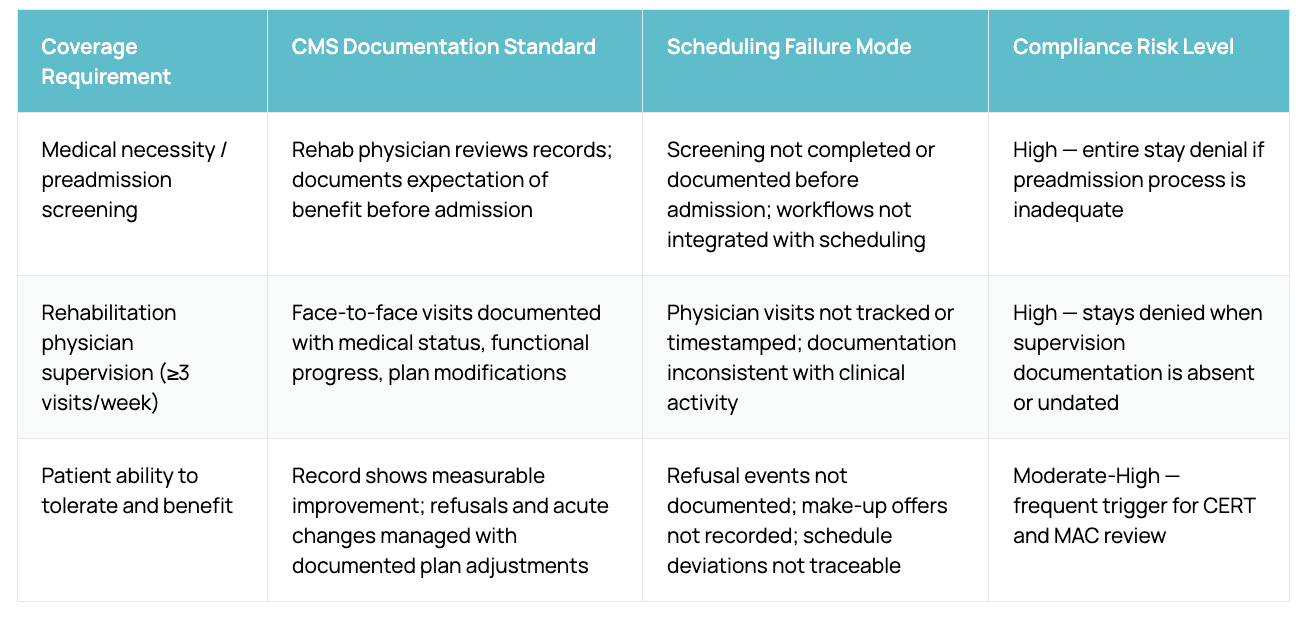
CMS requires that at the time of admission, the IRF have a reasonable expectation that the patient needs the multiple active and ongoing therapies of an intensive inpatient rehabilitation program, including physical or occupational therapy. The documentation must show that the patient could not be effectively treated in a less intensive setting and that the clinical team actively evaluated alternatives [4][5].
The scheduling connection: when a patient is admitted without a detailed preadmission screening — completed within the 48 hours before admission and documented by a rehabilitation physician who reviewed the patient's records — the admission itself is at risk. IRFs with scheduling systems that build preadmission screening checkpoints into the admission workflow are structurally more defensible; inadequate preadmission documentation was 1 of the 5 root causes OIG identified for the 175 of 220 failed audited stays [3].
Coverage Requirement 2: Rehabilitation Physician Supervision
CMS requires that a rehabilitation physician supervise the patient's care, visit the patient face-to-face at least 3 days per week, and document medical status, functional progress, and plan-of-care modifications in the medical record [4][5].
The scheduling connection: physician visit cadence is a scheduling output. CMS requires at least 3 face-to-face visits per week — and in facilities where those visits are tracked manually, the risk of a missed or undocumented visit is elevated [4][5]. When the daily schedule explicitly assigns physician visits alongside therapy sessions, the documentation trail is consistent, timestamped, and auditable.
Coverage Requirement 3: Patient Ability to Tolerate and Benefit
CMS requires that the patient must be sufficiently stable at admission to actively participate in and benefit from an intensive rehabilitation therapy program, and that the record must show measurable functional improvement of practical value. This requirement underpins both the admission decision and the ongoing clinical documentation during the stay [4][5].
The scheduling connection: when patients refuse sessions, experience acute medical changes, or are pulled for physician procedures during scheduled therapy time, the clinical record must show that these deviations were managed proactively — that make-up minutes were offered within the same 7-day window, that the rehabilitation team adjusted the care plan, and that the patient's trajectory toward discharge was maintained. A schedule that absorbs these events automatically and documents the make-up offer creates a compliant record. A schedule managed manually often cannot reconstruct the minute-level detail that audit review requires.
Coverage Requirement 4: The 900-Minute Therapy Rule and IRF-PAI Compliance
CMS requires that each Medicare patient in an IRF receive at least 900 minutes of PT, OT, and/or SLP therapy within each 7-day window of the stay — the intensive therapy requirement, also called the 3-hour rule [4]. This requirement applies to every rolling 7-day period, not just the first week, and must be documented in the IRF-PAI and the daily clinical record [5].
This is the requirement that most directly exposes scheduling failures in audit. When a patient's running total falls short of 900 minutes due to unrecovered refusals, physician conflicts, or equipment unavailability, the IRF faces a choice: attempt late-week recovery, document a physician-ordered medical exception, or submit a claim that will not survive medical review. OIG's nationwide audit sample found 175 of 220 stays failed Medicare requirements, and CMS's CERT program has found IRF error rates as high as 62% in prior audit periods [1][3]. Both findings trace disproportionately to therapy delivery and documentation failures — the operational output of how the daily schedule was built and managed.
"In fiscal year 2021, Medicare paid approximately $8.7 billion for 373,000 IRF stays nationwide. CMS has consistently found high IRF error rates through its Comprehensive Error Rate Testing program."
— OIG Work Plan: Inpatient Rehabilitation Facility Nationwide Audit, December 2024 [1]
Medicare IRF Coverage Requirements: What Gets Audited and How Scheduling Is the Link
The Audit Landscape: Why This Is Not Theoretical Risk
IRF claims have been under heightened OIG and CMS scrutiny since the IRF PPS was established. The American Hospital Association (AHA) represents more than 5,000 member hospitals and consistently tracks the regulatory environment for post-acute services, including IRF compliance obligations; AHA guidance underscores that IRF documentation and therapy delivery standards are among the highest-scrutiny compliance areas for hospital-based rehabilitation units [14]. The CERT program has measured IRF error rates in every review period, with rates ranging from 9% to 62% across audit periods — significantly above the Medicare program-wide improper payment rate [3]. These are not marginal compliance failures; they represent systematic gaps in the documentation and delivery processes that IRF billing depends on.
The 2018 OIG nationwide audit of IRF claims for calendar year 2013 found that 175 of 220 sampled stays failed Medicare coverage and documentation requirements, and extrapolated that finding to estimate $5.7 billion in nationwide payments for care not meeting Medicare standards — across $6.75 billion in audited payments to 1,139 IRFs [3]. The OIG identified five root causes: inadequate internal controls to prevent inappropriate admissions, lack of prepayment review, ineffective educational efforts, inconsistent ALJ appeal outcomes, and payment system incentives that did not align cost with payment [3].
In December 2024, OIG added a new nationwide IRF audit to its Work Plan (Project A-04-23-08096), following up on the 2018 findings and seeking stakeholder input on areas where CMS should clarify IRF payment criteria [1]. The announcement signals that audit intensity on IRF claims is increasing, not abating. For IRF CFOs and COOs planning compliance investments for 2025–2026, this is the operating environment: $8.7 billion in annual payments, historically high error rates, and a new OIG audit cycle launched in December 2024.
Why 20–30% of IRF Scheduling Error Rates Create the Specific Gaps That Auditors Target
The compliance failures that OIG identifies in IRF audit — missing physician documentation, unrecovered therapy minutes, inadequate preadmission screening — are not primarily clinical failures. They are documentation and scheduling failures that make clinical work invisible to the audit record. OIG found these failures in 175 of 220 audited stays [3], and the CERT program has measured IRF error rates as high as 62% in prior audit periods.
Opmed's IRF data finds that 20–30% of IRF scheduling error rates put compliance at risk, and that manual scheduling processes consume 4–5 hours of staff coordination time per day without producing the per-patient, per-session documentation trail that audit defense requires [Opmed IRF Handout 2026]. The pattern across manual scheduling environments is consistent: a patient refuses a Tuesday morning OT session. The scheduler re-assigns the patient to a late Wednesday slot. The make-up session occurs. But the documentation of the refusal, the offer, the reschedule, and the make-up delivery does not survive the weekend — because it lived in a whiteboard, a spreadsheet, or a coordinator's memory, not in a system of record the IRF-PAI submission reflects.
Under audit, that gap is a denial. The CERT contractor or OIG reviewer sees a claim asserting 900 minutes delivered; the medical record cannot reconstruct each session, each deviation, and each make-up with the specificity required. The OIG's standard for coverage is that the medical record must support the claim — not that the care was probably delivered, but that it is documented in a way that demonstrates it was delivered as claimed [3][4].
What Scheduling Infrastructure Changes the Reimbursement Equation
IRFs achieving 95% reimbursement approval do not do so by filing better claims forms. They do so by building a scheduling infrastructure that generates the documentation the IRF-PAI and the audit record require as a byproduct of daily operations — not as a separate compliance activity performed retroactively.
The four operational changes that move the approval needle: first, real-time 7-day compliance tracking at the patient level — every session delivered, every refusal documented, every make-up tracked against the rolling window, automatically. Second, physician visit scheduling that is integrated with the patient schedule and generates timestamped documentation of the face-to-face encounter in the clinical workflow. Third, preadmission screening workflow integration, so that the rehabilitation physician's review is completed and documented before or at the time of admission. Fourth, IRF-PAI preparation that pulls directly from the scheduling system's session records, so the minutes reflected on the assessment match the clinical record without manual reconciliation.
Opmed customers report 95% reimbursement approval within 60–90 days of implementing automated IRF scheduling, with 20–30% of previously at-risk schedules brought into documented compliance [Opmed][Opmed IRF Handout 2026]. The mechanism is not improved billing. It is the elimination of the gap between what clinical teams delivered and what the documentation can prove they delivered under audit.
For IRF CFOs and COOs ready to move from reactive audit exposure to a scheduling infrastructure that generates audit-defensible compliance documentation in real time, Opmed's rehabilitation scheduling platform is purpose-built for the 4 coverage requirements and 900-minute compliance demands of IRF operations. See Opmed's IRF rehabilitation solution →
Move from Reactive Audit Defense to Real-Time Compliance Assurance
Medicare IRF reimbursement is a per-discharge system that front-loads payment and back-loads scrutiny. Every stay is paid based on what the IRF-PAI says happened; every payment is at risk if post-payment review finds that the documentation cannot support what the claim asserts. With $8.7 billion in annual payments, CERT error rates that have reached 62%, and a new nationwide OIG audit cycle launched in December 2024, the compliance environment for IRF reimbursement is among the most demanding it has been in years [1][3].
The IRFs achieving 95% reimbursement approval are not running cleaner billing departments. They are running a scheduling infrastructure that generates audit-defensible documentation as a byproduct of how the daily schedule is built and managed — per-patient 7-day therapy tracking, integrated physician documentation, real-time refusal and make-up records, and IRF-PAI data that matches the clinical record without manual reconciliation.
See how Opmed customers reach 95% reimbursement approval — book a demo →
Related Resources
Continue exploring IRF reimbursement and scheduling compliance with these resources from the Opmed team:
What Is the CMS 900-Minute Rule? IRF Compliance Explained — Piece #2 in the IRF Scheduling Cluster: deep dive on the intensive therapy requirement
How to Reduce IRF Scheduling Errors Before They Trigger a Medicare Audit — Piece #20 in the IRF Scheduling Cluster
The Hidden Cost of Manual IRF Scheduling: Why EHRs and Spreadsheets Create Compliance Risk — Piece #14 in the IRF Scheduling Cluster
Why Rehab Therapist Burnout Is a Scheduling Problem, Not a Staffing Problem — Piece #6: the clinical-side companion to this compliance post
Opmed Rehabilitation Solution — Purpose-built IRF scheduling platform with real-time compliance tracking
Editorial Note
This article is for informational purposes for healthcare operations leaders and does not constitute clinical, legal, or financial advice. All compliance, reimbursement, and operational decisions should be made in consultation with qualified counsel, your facility's compliance team, and CMS guidance specific to your facility type and circumstances.
Opmed.ai is a healthcare operations platform; our outcomes data reflects aggregate performance across customer facilities and individual results will vary based on facility size, staffing, patient mix, and implementation scope.
Note: CMS IRF PPS requirements, payment rates, and audit criteria are updated through annual rulemaking. The figures and rules cited here reflect current guidance as of April 2026; always verify against the latest CMS publications at https://www.cms.gov/Medicare/Medicare-Fee-for-Service-Payment/InpatientRehabFacPPS at the time of operational and compliance decision-making.
Last reviewed: April 2026 by the Opmed Editorial Team.
References
OIG/HHS. Inpatient Rehabilitation Facility Nationwide Audit. Work Plan Project A-04-23-08096, announced December 11, 2024. https://oig.hhs.gov/reports/work-plan/browse-work-plan-projects/inpatient-rehabilitation-facility-nationwide-audit/ — accessed April 2026. [Medicare paid $8.7B for 373,000 IRF stays in FY2021; consistently high CERT error rates]
Medicare Payment Advisory Commission (MedPAC). Report to the Congress: Medicare Payment Policy, Chapter on Inpatient Rehabilitation Facilities — Payment Adequacy Analysis. March 2025. https://www.medpac.gov/wp-content/uploads/2023/10/Tab-F-IRF-payment-adequacy-December-2024_SEC.pdf — accessed April 2026. [MedPAC analysis documents that aggregate Medicare IRF margins have exceeded 13% since 2015, and that IRF per-discharge payments are structured at substantially higher rates than acute IPPS to account for the intensity of therapy services]
OIG/HHS. Many Inpatient Rehabilitation Facility Stays Did Not Meet Medicare Coverage and Documentation Requirements. A-01-15-00500. https://oig.hhs.gov/oas/reports/region1/11500500.asp — accessed April 2026. [175 of 220 stays failed; $5.7B estimated improper payments; CERT error rates 9%–62%; 5 root causes]
Centers for Medicare & Medicaid Services. Medicare Benefit Policy Manual, Chapter 1, Section 110: Covered Inpatient Rehabilitation Facility Services. https://www.cms.gov/Regulations-and-Guidance/Guidance/Manuals/Downloads/bp102c01.pdf — accessed April 2026.
Code of Federal Regulations. 42 CFR Part 412 Subpart P — Prospective Payment for Inpatient Rehabilitation Hospitals and Rehabilitation Units. https://www.ecfr.gov/current/title-42/chapter-IV/subchapter-B/part-412/subpart-P — accessed April 2026.
CMS. IRF Grouper — Case Mix Group (CMG). https://www.cms.gov/medicare/payment/prospective-payment-systems/inpatient-rehabilitation/grouper-case-mix-group — accessed April 2026. [CMG classification system; 25% PAI penalty for late submission]
CMS. Fiscal Year 2025 IRF Prospective Payment System Final Rule (CMS-1804-F), July 31, 2024. https://www.cms.gov/newsroom/fact-sheets/fiscal-year-2025-inpatient-rehabilitation-facility-prospective-payment-system-final-rule-cms-1804-f — accessed April 2026. [FY2025: 3.0% payment update; CMG relative weights; Pricer software; wage index]
Applied Policy. CMS Finalizes 2.6% Payment Increase — FY 2026 IRF Final Rule, August 2025. https://www.appliedpolicy.com/cms-finalizes-2-6-payment-increase-and-quality-reporting-changes-in-the-fy-2026-inpatient-rehabilitation-facility-final-rule/ — accessed April 2026.
[Opmed] Opmed.ai customer outcomes data, 2026. https://www.opmed.ai/ [95% reimbursement approval; individual results vary]
American Hospital Association (AHA). Hospital Statistics and Regulatory Resources for Post-Acute Services. https://www.aha.org — accessed April 2026. [AHA represents 5,000+ member hospitals; tracks IRF compliance and documentation standards as high-scrutiny areas for hospital-based rehabilitation units]
American Medical Rehabilitation Providers Association (AMRPA). IRF Compliance and Audit Vulnerability Tracking. https://www.amrpa.org — accessed April 2026. [AMRPA represents 700+ IRF facilities; therapy delivery documentation and physician supervision are most common post-payment audit vulnerability sources][Opmed IRF Handout 2026] Opmed.ai IRF Marketing Handout, 2026. https://www.opmed.ai/ [20–30% scheduling error rate; 4–5 hours manual scheduling per day; 175 of 220 OIG finding]